
Enhancing Health Through Discovery and Innovation
Latest News
The background image is A close-up image of laboratory equipment depicts test tubes, boxes and bottles on the shelf in a Penn State College of Medicine laboratory in summer 2016. Test tubes and one bottle are visible at left in focus, with other bottles out-of-focus to the right.
Navigate the Research Lifecycle
Click on the image below to learn how Penn State College of Medicine supports its investigators.
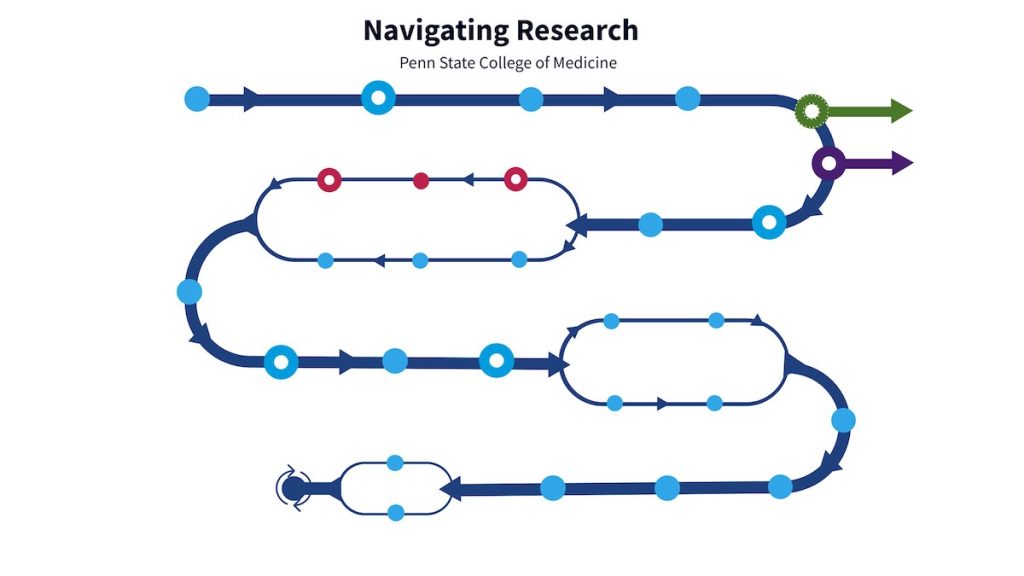
Connect with Resources and Expertise
Find a Collaborator
Pure, the University’s research networking tool, allows searchers to find relevant investigators and equipment by topic, department and more.
Use Shared Resources
Learn more about the College of Medicine’s core facilities, including specific instrumentation and services.
Tap Additional Expertise
The directory of College of Medicine departments, divisions, institutes and centers includes links to learn more about their interests, skills and specialties.
$90M awarded for biomedical research in 2018
17 clinical departments
350+ clinical trials
8 basic science departments
Penn State Health
Penn State Neuroscience Institute
Penn State Bone and Joint Institute
Penn State Heart and Vascular Institute
Penn State Clinical & Translational Science Institute
Penn State Cancer Institute
Penn State Institute for Personalized Medicine
7 master’s degree programs
DrPH Doctor of Public Health Program
MD/PhD Program
70+ postdoctoral scholars
Penn State Health Milton S. Hershey Medical Center